This article contains affiliate links. If you purchase through them, we may earn a small commission at no extra cost to you.
Walk into any supplement shop and you'll find an entire wall dedicated to protein powder. Dozens of brands, three different types of whey, flavors you've never heard of, and prices ranging from dirt cheap to inexplicably expensive.
The sales pitch is always the same: more protein = more muscle, and their particular blend will get it to your muscles faster, cleaner, and more efficiently than the competitor next to it on the shelf.
Most of that is marketing. Some of it is real. The tricky part is knowing which is which.
This guide cuts through it all — what whey actually is, what the three types genuinely differ on, whether timing matters, and most importantly: whether you actually need it in the first place.
- Whey is a complete protein — all 9 essential amino acids, highest leucine content of any natural food protein.
- Concentrate vs. Isolate vs. Hydrolysate — the differences are real but much smaller than the price gap suggests.
- Timing matters less than total daily protein. The "anabolic window" is much wider than gym culture suggests.
- Protein powder is a convenience tool, not a necessity. Food comes first. Powder fills gaps.
- Safe for most people. Not a steroid, not a fat-gainer, not hard on healthy kidneys.
What Whey Protein Actually Is
Whey is a byproduct of cheese production. When milk is curdled to make cheese, it separates into two components: solid curds (casein) and liquid whey. That liquid is collected, filtered, and dried into powder. That's whey protein.
It's not synthetic. It's not a drug. It's a food processing byproduct that happens to be exceptionally rich in protein — specifically in the amino acids most critical for muscle protein synthesis.
What makes whey particularly useful for muscle building is its amino acid profile. It's a complete protein, meaning it contains all nine essential amino acids your body can't produce on its own. It's also the highest natural source of leucine — the key amino acid that triggers muscle protein synthesis (MPS).
Leucine acts as a metabolic switch. Once it crosses a certain threshold in the bloodstream (~2–3g per dose), MPS gets activated. Whey delivers that threshold reliably in a single serving. Most plant proteins don't, which is why combining plant sources matters for vegans.
Muscle protein synthesis isn't triggered by total protein consumed — it's triggered by leucine concentration in the blood. This is why protein quality (amino acid profile) matters, not just grams on the label. Whey consistently reaches the leucine threshold in a single standard serving. Collagen protein, for comparison, has almost no leucine and does almost nothing for MPS.
The Three Types: Concentrate, Isolate & Hydrolysate
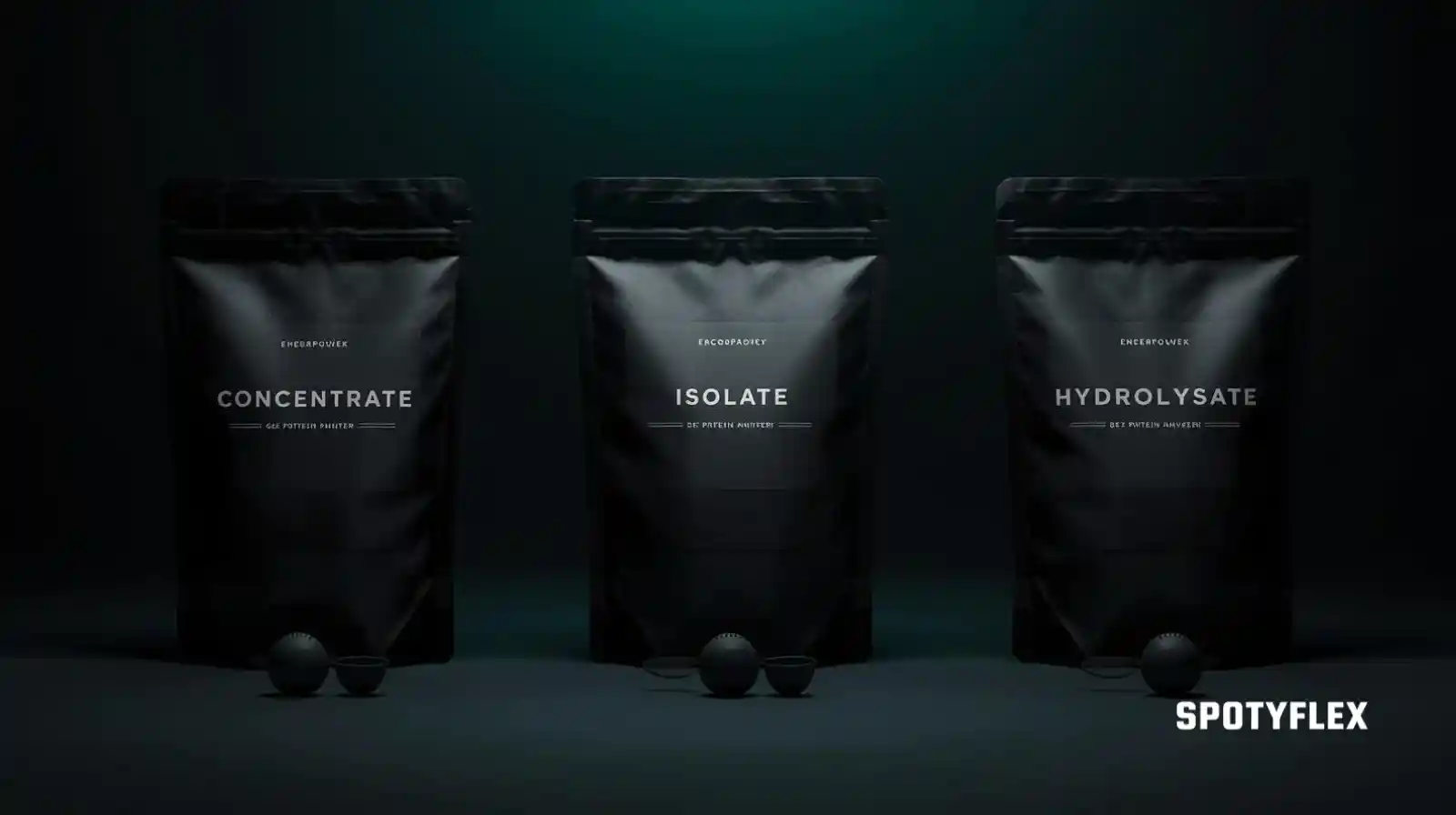
The supplement industry treats these three types as if they're drastically different products with drastically different results. The reality is more nuanced — the differences are real but rarely justify the price premiums charged.
The least processed form. After filtering the liquid whey, concentration sits at 70–80% protein, with the remaining 20–30% being carbohydrates (lactose) and fats. These aren't negatives — the fat content in concentrate may actually preserve some beneficial bioactive compounds like immunoglobulins that get stripped in heavier processing.
Further filtered to remove most of the lactose and fat, leaving 90%+ protein. The practical result is a slightly cleaner macro profile — useful if you're tracking tightly — and dramatically lower lactose, making it the go-to for people who are lactose intolerant or experience digestive discomfort with concentrate.
Concentrate or isolate that's been partially broken down (hydrolyzed) by enzymes — essentially pre-digested into smaller peptides for faster absorption. This is marketed as faster muscle recovery. The absorption advantage is real but small in practical terms: whey isolate already absorbs within 60–90 minutes. Hydrolysate shaves maybe 15–20 minutes off that. For most people, this difference is irrelevant.
For 80% of people, whey concentrate is the correct answer. If you have lactose sensitivity, get isolate. Hydrolysate is a specialty product — don't let a clever label convince you it's meaningfully better for standard use.
Do You Actually Need Protein Powder?
Short answer: probably not. But it's a useful tool for a specific problem.
Protein powder exists to solve a convenience problem, not a biochemical one. Your muscles don't care whether the protein came from a scoop of powder or a chicken breast — once it's digested, it's amino acids. The source is irrelevant to your muscle cells.
What matters is hitting your total daily protein target. If you can do that through whole food — eggs, meat, fish, dairy, legumes — consistently and without difficulty, you don't need powder. Full stop.
Where powder earns its place:
High protein targets are hard to hit through food alone. Reaching 160–200g of protein per day from food is genuinely difficult for many people, especially those with small appetites, busy schedules, or dietary restrictions. A shake adds 25–30g with minimal prep time.
Post-workout convenience. Having a shake immediately after training is faster than cooking a meal. If the alternative is skipping protein post-workout, the shake wins.
Cost-per-gram efficiency. Quality whey protein runs roughly $0.03–0.05 per gram of protein. Chicken breast is around $0.03–0.06 depending on where you live. Powder is cost-competitive with lean whole food protein sources.
Whole food protein sources come with micronutrients, satiety compounds, and a food matrix that affects digestion differently. Don't replace meals with shakes. Use powder to fill gaps in your daily intake — not as the foundation of your protein strategy.
How Much Protein Do You Need Per Day?
The evidence-based target for active adults doing resistance training is 1.6–2.2g of protein per kg of bodyweight per day. A 75kg person needs roughly 120–165g of protein daily. The upper end of the range is for those in a caloric deficit, where higher protein helps preserve lean mass.
The old "1g per pound of bodyweight" rule (which translates to ~2.2g/kg) is the upper ceiling, not the minimum. Research shows diminishing returns above 2.2g/kg for most people — eating 3g/kg doesn't produce proportionally more muscle.
See our full breakdown: How Much Protein Do You Actually Need Per Day?
Timing: Does It Actually Matter?

The "anabolic window" — the idea that you must consume protein within 30 minutes of your last rep or your gains vanish — is one of the most persistent myths in gym culture.
Here's what the research actually shows: muscle protein synthesis remains elevated for 24–48 hours after a resistance training session. Your muscles are receptive to amino acids for a long time after you train, not just the first 30 minutes.
A large meta-analysis by Brad Schoenfeld and Alan Aragon found that when total daily protein intake was equated, the timing of protein consumption had no meaningful effect on muscle growth or strength gains. What mattered was hitting the daily target — not when in the day you hit it.
| Timing Belief | What Research Says | Verdict |
|---|---|---|
| "Must eat within 30 min post-workout" | MPS window is 24–48h, not 30 min | △ Convenient, not critical |
| "Pre-workout protein fuels the session" | If you ate a meal 2–3h before, protein is still circulating | △ Only useful if fasted |
| "Spreading protein across 4+ meals is optimal" | Mild benefit — ~3–4 protein feedings per day performs slightly better than 1–2 | ✓ Mild, real benefit |
| "Protein before bed builds muscle overnight" | Casein (slow-digesting) before bed shows modest additional MPS during sleep | ✓ Small, real benefit — casein, not whey |
| "Total daily protein is all that matters" | Dominant factor in all studies by a large margin | ✓ This is the big lever |
Have protein post-workout if it's convenient — it's a good habit and won't hurt. But don't stress if you're 90 minutes late to the shake. The difference between a post-workout shake at 15 minutes vs. 2 hours is essentially zero if your daily intake is consistent. Hit your daily total first. Time it second.
How to Choose and What to Avoid
The protein powder market is full of products that look impressive on the label and underdeliver in the tub. Here's how to read past the marketing:
Amino spiking (adding cheap free-form aminos like glycine to inflate nitrogen readings — which inflates the protein number on the label). Digestive enzyme blends in premium products (your own gut handles it fine). "Anabolic" or "mass gainer" whey (just whey + lots of maltodextrin = cheaper calories you could get from oats). Exotic protein blends mixing 5 different sources — no research advantage over standard whey for most people.
5 Whey Protein Myths, Debunked

Side Effects and Who Should Be Careful
Whey protein has an excellent safety profile for the vast majority of people. Decades of research show no adverse effects in healthy individuals at typical doses (1–2 scoops per day).
Digestive discomfort. The most common side effect, and almost always caused by lactose sensitivity — whey concentrate contains 3–5g of lactose per serving. The fix is switching to whey isolate (<1g lactose) or a lactase enzyme supplement. Not a protein problem, a lactose problem.
Acne. Some research suggests dairy proteins may exacerbate acne in susceptible individuals via IGF-1 signaling. The evidence is not strong enough to make a blanket recommendation, but if you notice a correlation between starting whey and skin breakouts, it's worth experimenting with a break or switching to plant protein.
Bloating and gas. Can occur from consuming large amounts quickly, or from artificial sweeteners in flavored products (sucralose, sorbitol). Switching to unflavored or naturally sweetened products often resolves this.
People with pre-existing kidney or liver disease should consult a physician before significantly increasing protein intake. People with a milk protein allergy (distinct from lactose intolerance — this is an immune response to the protein itself, not the sugar) should avoid whey entirely and use plant-based alternatives.
Hit Your Target.
Powder Is Just
a Tool.
Whey protein is one of the highest-quality, most cost-effective protein sources available. Concentrate for most people, isolate if lactose-sensitive. Timing matters less than consistency. No single supplement replaces a solid diet — but if you're short on daily protein, whey is the most efficient way to close the gap.
The supplement industry wants you to believe protein powder is complicated — that you need to match the right type, nail the exact timing window, and buy the premium formula. None of that is true.
Get your daily protein target from mostly whole foods. Use whey to fill the gap when food isn't convenient. Buy the cheapest option that passes a third-party test. Everything else is noise.
Frequently Asked Questions
Can I replace meals with whey protein shakes?
Occasionally, as a backup — not as a habit. Whole food meals provide fiber, micronutrients, water content, and satiety compounds that a protein shake doesn't. Using shakes to replace meals long-term leads to micronutrient gaps. Replace the odd missed meal, not your eating pattern.
Does whey protein expire? Is it still usable after the best-before date?
The "best before" date applies to flavor and texture quality, not safety. Properly stored whey (cool, dry, sealed) is typically safe and functional well past its date — the protein doesn't degrade significantly. If it smells fine and mixes without clumping excessively, it's usually fine.
Should I take whey on rest days?
Yes — your daily protein target applies on rest days too. Muscle protein synthesis is elevated for 24–48 hours post-training, meaning your recovery day is still a day your muscles are actively using amino acids. Don't skip protein on rest days.
Is whey protein safe for teenagers?
In principle, whey is just food — it's not inherently unsafe. However, most sports nutrition bodies recommend teenagers prioritize getting protein from whole foods and avoid relying on supplements, both because nutrient needs differ and because the habit of supplement dependency early isn't ideal. If a teenager genuinely can't hit protein targets from food, whey is not dangerous.
Whey vs. casein — what's the difference?
Both are milk proteins. Whey is fast-digesting (peak amino acids in bloodstream ~60–90 min) — good post-workout or for hitting daily targets efficiently. Casein is slow-digesting (trickles amino acids over 5–7 hours) — often recommended before bed to support overnight muscle protein synthesis. Research supports a modest benefit of casein before sleep. They serve slightly different purposes.
- Morton RW, et al. A systematic review, meta-analysis and meta-regression of the effect of protein supplementation on resistance training-induced gains in muscle mass and strength. British Journal of Sports Medicine, 2018
- Schoenfeld BJ, Aragon AA. Is there a postworkout anabolic window of opportunity for nutrient consumption? Journal of the International Society of Sports Nutrition, 2013
- Tang JE, et al. Ingestion of whey hydrolysate, casein, or soy protein isolate: effects on mixed muscle protein synthesis at rest and following resistance exercise in young men. Journal of Applied Physiology, 2009
- Antonio J, et al. A high protein diet has no harmful effects: a one-year crossover study in resistance-trained males. Journal of Nutrition and Metabolism, 2016
- Res PT, et al. Protein ingestion before sleep improves postexercise overnight recovery. Medicine & Science in Sports & Exercise, 2012
- Comprehensive evidence summary on whey protein. Examine.com — Whey Protein
Younes Ouba
Founder of SpotyFlex, Full-Stack Developer & lifelong fitness enthusiast. I build the platform and the content. The goal is always the same: real fitness knowledge, zero BS.