Ask ten people in the gym how much protein they eat and you'll get ten different answers. "One gram per pound of bodyweight." "Two grams per kilo." "I just try to hit 150 grams." "My coach said 200 grams minimum." "I don't count, I just eat a lot of chicken."
Everyone's heard they need protein. Almost nobody knows exactly how much — or why.
The fitness industry has made this way more complicated than it needs to be. Supplement brands want you to believe you need heroic amounts so you buy more powder. Minimalists say the RDA is enough. Neither camp is being straight with you.
Here's the science — clean, direct, no agenda.
In This Article
Why protein is non-negotiable
Your body uses protein for basically everything that matters. Muscle repair. Enzyme production. Hormone synthesis. Immune function. Even your hair and nails are mostly protein.
But in a fitness context, the reason protein keeps coming up is simpler than that: your muscles are made of it.
When you train, you create micro-tears in your muscle fibres. Protein — specifically the amino acids it's broken down into — is what your body uses to rebuild those fibres. Bigger, stronger. That's literally the process. No protein, no repair. No repair, no growth. The gym is just the trigger. Protein is the building material.
And it doesn't stop there. Protein has a massive advantage for fat loss too:
- It's the most satiating macronutrient — it keeps you full longer than carbs or fat
- It has the highest thermic effect — your body burns ~20–30% of protein calories just digesting it
- It preserves muscle when you're in a calorie deficit — which keeps your metabolism from tanking
 02
02
What the actual research says
Here's where things get interesting — and where a lot of people get misled.
The official RDA (Recommended Dietary Allowance) for protein is 0.8 grams per kg of bodyweight. So for an 80kg person, that's 64 grams a day. Sounds low, right? That's because it is — for anyone who trains.
The sports nutrition research is much more consistent. Across dozens of studies looking at resistance-trained individuals, the range that keeps coming up for muscle gain and preservation is 1.6 to 2.2 grams per kg of bodyweight per day.
Above 2.2g/kg? Studies consistently show diminishing returns. You're not building more muscle — you're just excreting more nitrogen and spending more money on food. The old "1 gram per pound" (about 2.2g/kg) rule that gyms have pushed forever is actually at the very top of the useful range. Not wrong, but not the magic number it was treated as either.
The number you should hit (by goal)
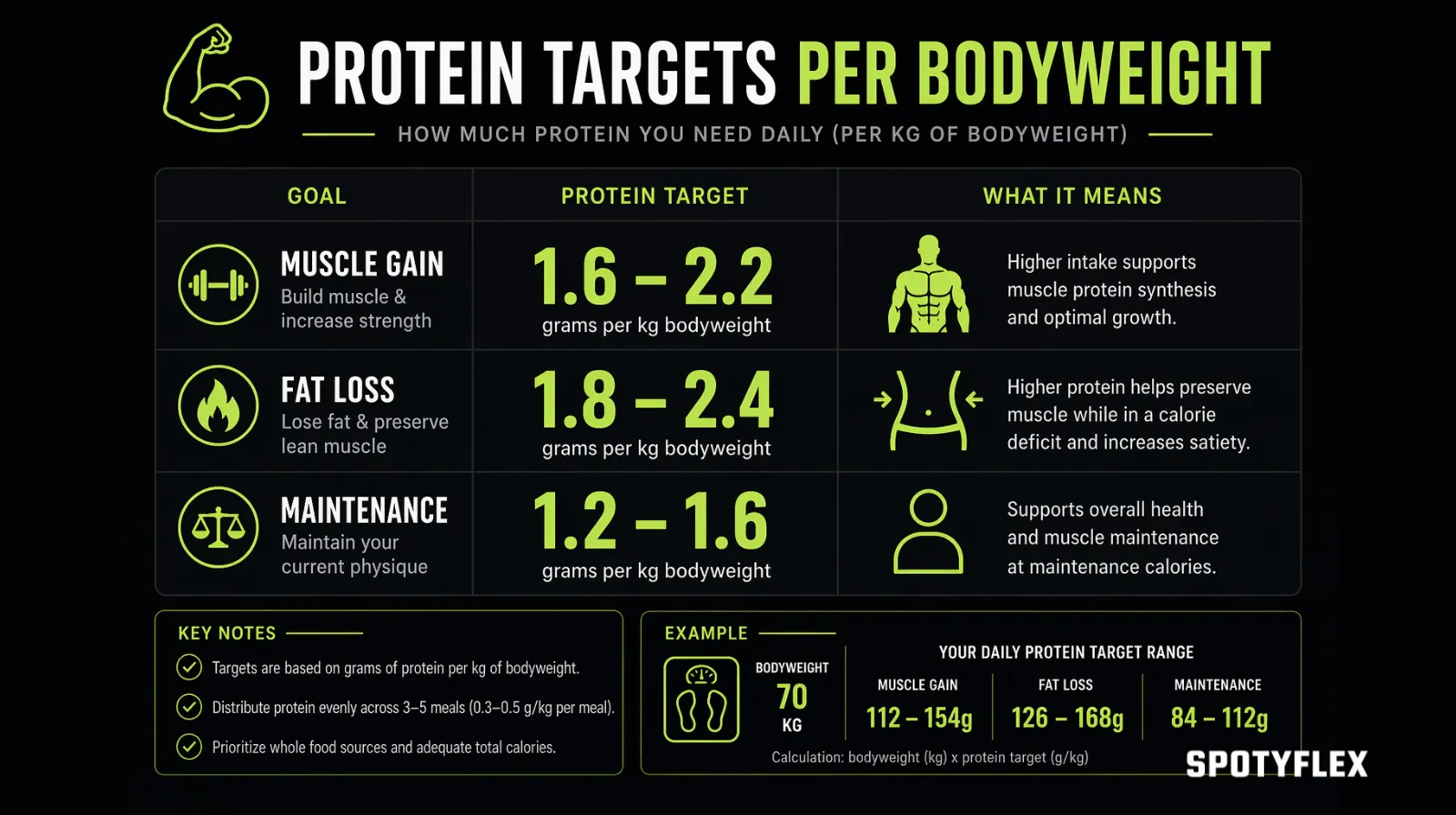
Forget the generic "eat more protein" advice. Here's a concrete target based on what you're actually trying to do.
| Your Goal | Recommended Range | Example (75kg person) |
|---|---|---|
| Maintain / general health | 1.2 – 1.6g / kg | 90 – 120g / day |
| Build muscle (lean bulk) | 1.6 – 2.2g / kg | 120 – 165g / day |
| Fat loss (calorie deficit) | 2.0 – 2.4g / kg | 150 – 180g / day |
| Aggressive cut / competition prep | 2.4 – 3.1g / kg | 180 – 230g / day |
| Older adults (40+) | 1.8 – 2.4g / kg | 135 – 180g / day |
A couple of notes on the table above. The ranges for older adults are higher because muscle protein synthesis becomes less efficient with age — a phenomenon called anabolic resistance. You need more protein to get the same response you'd get at 25. If you're over 40 and still targeting 1.6g/kg, you're leaving results on the table.
Also worth saying: these numbers are based on lean body mass, not total bodyweight, if you're significantly overweight. Someone who's 120kg with 40% body fat doesn't need the protein intake of a 120kg athlete. Base it on your target weight or use a body fat estimate.
 04
04
Does timing matter?
The short answer: less than hitting your daily total.
For years, the fitness world was obsessed with the "anabolic window" — the idea that you had 30–60 minutes post-workout to eat protein or the whole session was basically wasted. That window turns out to be much wider than originally thought. More like 3–5 hours on either side of your session.
That said, timing does have some evidence behind it when optimised. Here's what actually holds up:
Spread it across the day
Your body can only utilise around 20–40g of protein for muscle protein synthesis per meal. Eating 180g in two sittings is not as effective as spreading it across 4–5 meals. Each protein hit triggers a new synthesis response. More frequent triggers = more total muscle building over time.
Post-workout protein is worth having
Even if the window is wider than we thought, having protein within a few hours of training is still optimal. A protein shake or meal immediately after training is convenient and has a real (if modest) edge over eating nothing and waiting until dinner.
Pre-sleep protein is underrated
Casein protein (found in cottage cheese, Greek yogurt, milk) digests slowly. Eating a casein-rich food before bed gives your muscles a steady supply of amino acids during the overnight recovery window — when most of the actual repair happens.
 05
05
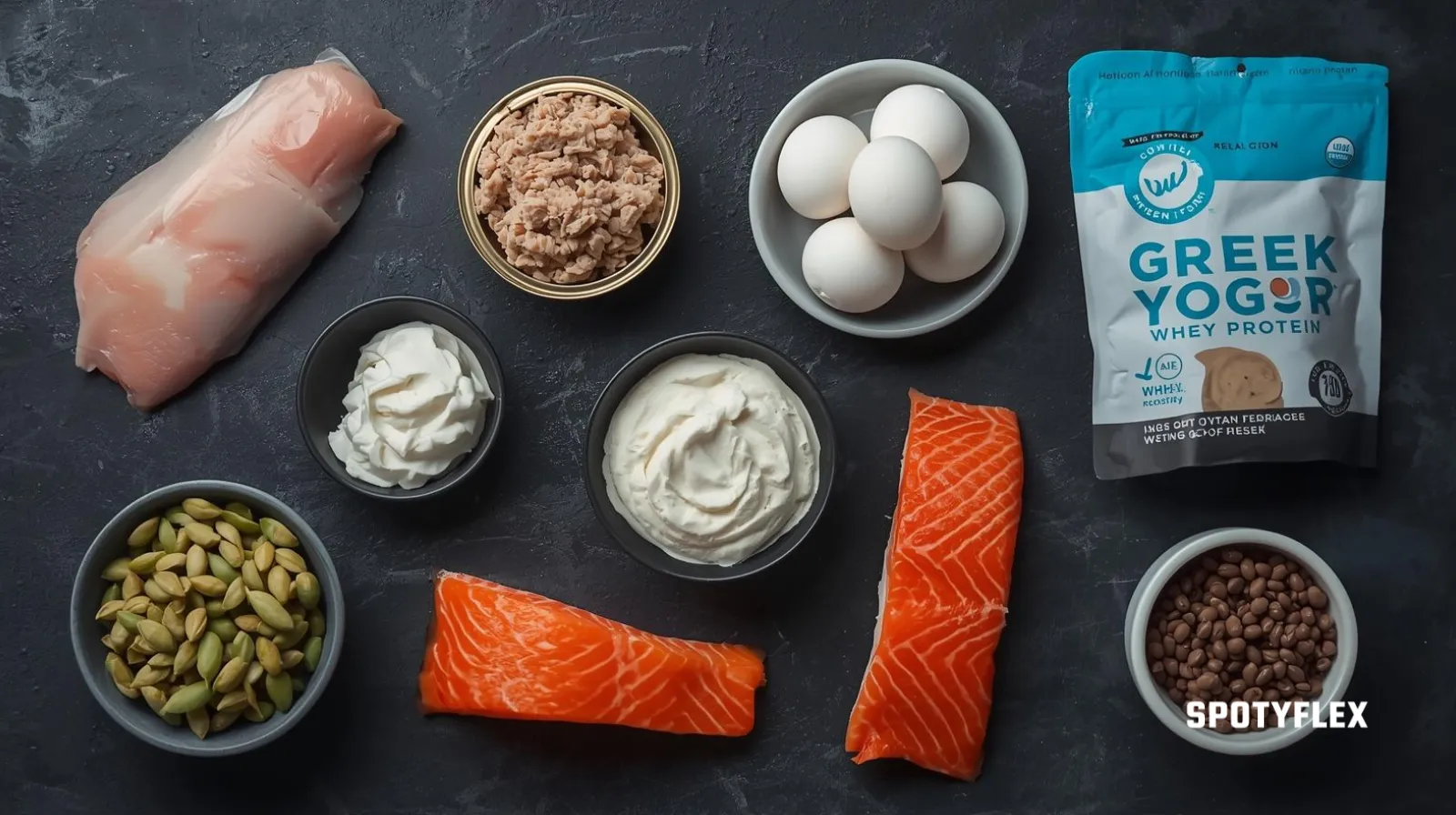
Best protein sources — ranked
Not all protein is equal. The key metric here is leucine content and bioavailability — how much of the protein your body can actually absorb and use for muscle synthesis.
Animal proteins generally win this race because they're "complete" — containing all essential amino acids in useful ratios. Plant proteins are not worse as a category, but you need to be more deliberate about combining sources.
| Food | Protein per 100g | Notes |
|---|---|---|
| Chicken breast (cooked) | ~31g | The standard. Versatile, lean, cheap. |
| Tuna (canned in water) | ~26g | Highest protein per cost. Easy macro hit. |
| Cottage cheese | ~11g | Casein-dominant. Great pre-sleep option. |
| Greek yogurt (0% fat) | ~10g | Casein + whey. Easy to eat, high satiety. |
| Eggs (whole) | ~13g | Highest bioavailability of any whole food. |
| Whey protein powder | ~80g | Fast-digesting. Post-workout ideal. |
| Salmon (cooked) | ~25g | Protein + omega-3. Double benefit. |
| Beef (lean cuts) | ~26g | High creatine content as a bonus. |
| Lentils (cooked) | ~9g | Good plant source. Pair with rice for complete amino profile. |
| Edamame | ~11g | Rare complete plant protein. |
 06
06
Common mistakes people make
Counting protein grams from the total food weight
100g of raw chicken is not 31g of protein. Cooked chicken breast gives you roughly 31g per 100g. Raw chicken is closer to 22–24g per 100g because it contains more water. This sounds minor but compounds over a full day of tracking. Use cooked weights or track by raw weight using raw food database entries — don't mix the two.
Front-loading protein at dinner
Many people eat a low-protein breakfast, a medium lunch, then hit all their protein at dinner. As we covered in the timing section, your body has a ceiling for how much protein it uses for muscle synthesis per sitting. Spreading it across meals is more effective than saving a massive steak for 8pm.
Relying on shakes and ignoring whole food
Protein powder is a useful tool for convenience. It is not a meal replacement strategy. Whole food proteins come packaged with micronutrients, satiety factors, and fibre that shakes don't replicate. Use shakes to fill gaps, not as your primary protein source.
Not adjusting for bodyweight changes
Your protein target is tied to your bodyweight (or lean mass). If you've lost 10kg over a cut, your target has changed too. Recalculate every 4–6 weeks if your weight is moving.
Thinking more is always better
Past ~2.2g/kg for most people, extra protein doesn't build more muscle. It just gets oxidised for energy or converted to glucose. You'd be better off spending those calories on carbs for training performance, or fat for hormonal health.
 07
07
How to hit your target every day
Knowing the number is step one. Actually hitting it consistently is where most people fall apart. Here's a practical framework.
Step 1: Calculate your target
Take your bodyweight in kg. Multiply by 1.8 if you're building muscle, or 2.2 if you're in a fat loss phase. That's your daily minimum in grams.
Step 2: Anchor every meal around a protein source
Don't plan meals and then check if there's enough protein. Start with the protein, then build the meal around it. Breakfast: eggs or yogurt. Lunch: chicken, tuna, or tofu. Dinner: meat, fish, or legumes. Snack: cottage cheese or a shake if you're still short.
Step 3: Use a quick tracker for 2–3 weeks
You don't need to track forever. But if you've never tracked your protein intake before, do it for two to three weeks until you develop an accurate intuition for what your meals contain. Most people discover they were eating 30–40% less protein than they thought.
Step 4: Keep high-protein foods accessible
Meal prep a batch of chicken or hard-boil a dozen eggs on Sunday. Keep cottage cheese and Greek yogurt stocked. Have a protein powder you don't hate. When you're tired and hungry, you eat whatever is easiest. Make the easy option the high-protein option.
Step 5: Don't stress about single days
One low-protein day won't erase your progress. Chronically missing your target week after week will. The goal is a consistent average over time, not perfection on any individual day.

Key Takeaways
- The RDA (0.8g/kg) is a deficiency-prevention floor — not a fitness target
- For muscle gain, aim for 1.6–2.2g per kg of bodyweight per day
- For fat loss, go higher: 2.0–2.4g/kg to protect muscle while cutting
- Older adults (40+) need more protein due to anabolic resistance — aim for 1.8–2.4g/kg
- Spread protein across 4–5 meals rather than front-loading at dinner
- Whole food first, shakes as a supplement to fill gaps
- Pre-sleep casein (cottage cheese, Greek yogurt) is a legit and underused strategy
- Above 2.2g/kg for most people, extra protein gives diminishing returns
Protein is the one macronutrient where almost nobody eats too much and almost everybody eats too little. Get the number right, spread it through the day, and build your meals around it — and you've solved probably 80% of the "why am I not making progress" question.
The gym tears the muscle. The food builds it back. Don't skip either half.
- Morton RW, et al. A systematic review, meta-analysis and meta-regression of the effect of protein supplementation on resistance training-induced gains in muscle mass and strength. PubMed — British Journal of Sports Medicine, 2018
- Stokes T, et al. Recent perspectives regarding the role of dietary protein for the promotion of muscle hypertrophy with resistance exercise training. PubMed — Nutrients, 2018
- Helms ER, et al. A systematic review of dietary protein during caloric restriction in resistance trained lean athletes. PubMed — International Journal of Sport Nutrition, 2014
- Res PT, et al. Protein ingestion before sleep improves postexercise overnight recovery. PubMed — Medicine & Science in Sports & Exercise, 2012
- Comprehensive evidence summary on daily protein intake targets. Examine.com — Protein Intake Guide
Younes Ouba
Founder of SpotyFlex, Full-Stack Developer & lifelong fitness enthusiast. I build the platform and the content. The goal is always the same: real fitness knowledge, zero BS.