



Almost nobody fails at fitness because of a bad workout. They fail because they show up expecting a movie montage and quit when week three feels boring. This is the roadmap I wish someone had handed me when I started: a realistic 90-day plan split into three phases, an honest answer to "how many days should I train," nutrition basics that don't require a nutrition degree, and the exact things worth tracking so you're not just guessing whether any of this is working.
In this article
- Why starting fitness feels so confusing
- The first principle: build the habit before the body
- Your first 90-day fitness plan
- How many days a week should beginners train?
- Beginner workout principles that actually matter
- Nutrition basics without overcomplicating it
- Common beginner mistakes
- How to measure progress
- Supplements: what beginners actually need
- Final 90-day checklist
Why Starting Fitness Feels So Confusing
Here's a fun experiment: search "best beginner workout" right now and watch three different creators tell you three opposite things in the first ten results. One says cardio first. One says cardio is a waste of your time. One's selling you a 30-day "shred" program that conveniently never mentions what happens on day 31. Nobody's lying exactly, they're just all talking to different people, and you, the actual beginner, got stuck in the crossfire.
The truth is there's more fitness information available today than at any point in human history, and somehow that's made things harder, not easier. Most of it is written by people training for people who are already training. Optimizing the last 10%. Meanwhile you just want to know what to actually do this Monday morning, without needing a kinesiology degree to decode it.
I'll save you some time: you don't need the optimized version yet. You need a starting point, a couple of habits that don't fall apart by Thursday, and permission to ignore 90% of what's trending. That's basically what got me through my own first few months, long before I knew what "progressive overload" even meant. If you want a slightly different angle on the same early-days chaos, I wrote about it in our beginner's roadmap to starting workouts too.
And here's the part almost nobody says out loud: most beginner mistakes aren't really mistakes, they're just things done in the wrong order. Worrying about the "perfect" program before trying any program. Stressing about supplement timing before sleep is even sorted. None of that makes you dumb. It just means nobody handed you the order of operations. That's what this article is.
So let's say it plainly, because it's the one sentence this entire guide is built on: consistency beats perfection. A mediocre plan you actually do for 90 days will smoke a "perfect" plan you quit after twelve days. Every time.
The First Principle: Build the Habit First
Before we touch sets, reps, or macros, let's talk about why people actually quit. Spoiler: it's almost never the programming. I've seen people quit great programs and stick with mediocre ones, and the difference was never the spreadsheet.
Realistic Expectations
In 90 days, you will not look like a different person. I wish someone had just said that to me on day one instead of letting me find out the hard way around day 60. What you will get, if you actually show up, is noticeably more strength, a bit more muscle tone, probably a little less fat, and clothes that sit differently. That's the real version. The dramatic "transformations" you scroll past usually involve a much longer timeline, flattering lighting, a strategic pump, or sometimes things that have nothing to do with training at all. Aim for "steady and real," not "movie montage," and you'll actually stick around long enough to get there.
Motivation vs. Discipline
Motivation is a mood. It shows up big and loud in week one and quietly leaves around week three, regardless of how good your plan is, that's just how it works for basically everyone. Discipline is the boring decision you made last Sunday, before the mood showed up to wreck your Tuesday evening plans.
Practical Tip
Pick your training days and rough times at the start of the week, not in the moment you're deciding whether to go. Removing the live decision removes the live excuse.
Tracking Progress
You don't need anything fancy here, a notes app is fine. What you trained, roughly how much, how it felt. Without that, your brain defaults to vibes ("I don't feel any different") instead of facts ("I added 10kg to my squat in six weeks, actually"), and vibes lie to you constantly in the first few months.
Why Beginners Quit
There's decent research behind this, and it lines up with what I've watched happen to friends, clients, and honestly myself. Self-determination theory research suggests that more autonomous and intrinsic forms of motivation are associated with better long-term adherence to physical activity. Translated out of academic-speak: people who train because they like how it makes them feel tend to stick around longer than people training purely to look different by some deadline. Appearance goals aren't bad, they just don't hold up well when they're the only reason in the room.
Your First 90-Day Fitness Plan
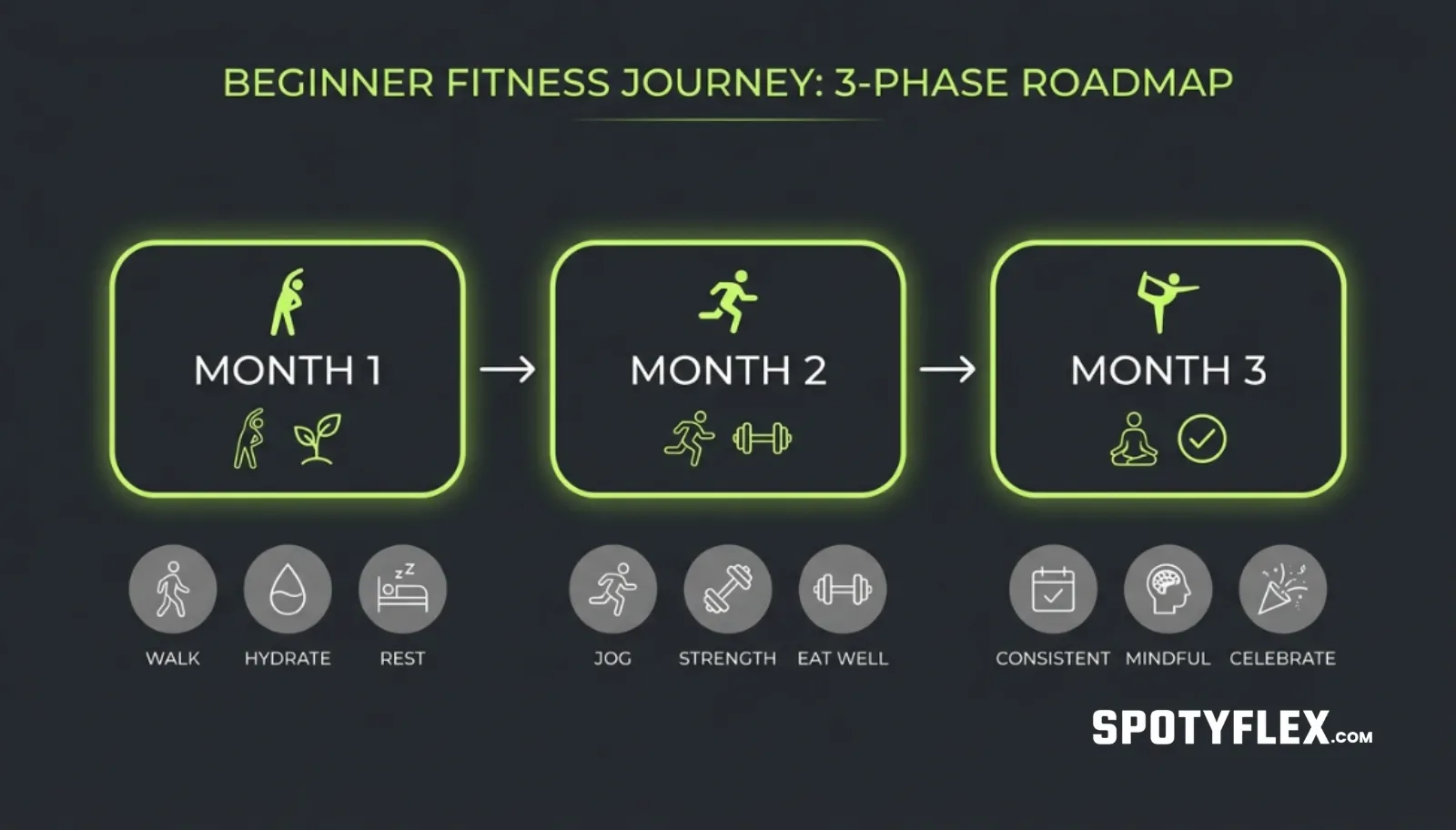
Ninety days is the sweet spot. Long enough to actually build a habit and see real numbers move. Short enough that "month four" doesn't feel like some far-off mythical land. Splitting it into three phases gives each month an actual job, instead of just repeating the same vague "get fit" goal for twelve weeks straight.
Phase 1: Weeks 1–4 — Foundation
Month one has exactly three jobs: learn the movements, build the habit of showing up, don't get hurt. That's it. If you finish a set in week two and think "that felt easy," good. That's the plan working, not the plan failing.
- Learning exercises: Stick to a handful of compound movements (squat, hinge, push, pull, carry) and rehearse them with light to moderate loads until they feel less like a puzzle and more like, well, just moving.
- Training frequency: 2–3 full-body sessions a week is genuinely plenty here. Enough stimulus to start adapting, not enough to wreck a body that's brand new to this.
- Full-body workouts: Train the whole body each session rather than splitting by muscle group, your body isn't ready to specialize yet. Our 3-day full-body workout plan is a solid plug-and-play option if you don't want to design your own this early.
- Recovery: Being sore in weeks one and two is normal, almost expected, it's not a badge of honor and it's not a warning sign either. Walk a bit on off days and it'll fade quicker than you think.
Phase 2: Weeks 5–8 — Building Momentum
By now the movements should feel less like a checklist and more like, well, yours. This is where you start asking your body for slightly more than last month, on purpose.
- Progressive overload: Small, steady increases in weight, reps, or sets, over time, is basically the entire engine behind getting stronger and building muscle. I broke down exactly how to apply this without overthinking it in our progressive overload guide.
- Increasing difficulty: Could mean a bit more weight, an extra rep or two, or adding a fourth session if your schedule and recovery genuinely allow it. Doesn't have to be dramatic.
- Improving technique: Now that you're not white-knuckling your way through every rep, tighten things up, squat depth, press range of motion, controlling the lowering phase. Cleaner technique now means fewer plateaus and fewer nagging aches later.
Phase 3: Weeks 9–12 — Building Your System
Last month's job is turning this temporary 90-day experiment into something you can actually keep running long after day 90, because that's the entire point.
- Choosing goals: By now you'll probably have a leaning, more drawn to strength, more drawn to muscle, more drawn to just feeling capable and healthy. Let that nudge your training focus instead of forcing yourself to follow a generic template forever.
- Adjusting training: Tweak frequency, exercises, or rep ranges based on what's actually worked over the last two months. This is normal fine-tuning, not the "program hopping" we'll talk about in a minute, there's a real difference.
- Creating a sustainable routine: The real test of these 90 days isn't a before-and-after photo. It's whether you can picture yourself still doing this on day 180 without dreading it. If the routine feels miserable, fix the routine, don't just white-knuckle through it.
12
weeks is genuinely enough time to build a real training habit and see measurable strength gains, no drastic life overhaul required
How Many Days Per Week Should Beginners Train?
There's no universally "correct" number here, and I'm always a little suspicious of anyone who tells you there is. There is, however, a correct way to pick one: match it to your actual life and recovery, not to whatever number sounds the most impressive on a fitness influencer's bio.
2 Days a Week
This is the right call if your schedule is genuinely tight, your job is draining, or you're coming back after a long break from any kind of activity. Two solid full-body sessions a week still move the needle on strength, and more importantly, you'll actually keep doing them.
3 Days a Week
The default I recommend to most beginners, honestly. Full-body training with a rest day in between gives plenty of recovery time for a body that's new to lifting, without asking for a huge time commitment.
4+ Days a Week
This is for people who already have some training under their belt, genuinely enjoy being in the gym, and have the flexible schedule to recover properly. Jumping straight to four-plus days as a true beginner is one of the more reliable ways to burn out or pick up an overuse injury before you've even gotten anywhere.
Who Each Option Fits
2 days: packed schedules, coming back from a break. 3 days: most beginners, balanced life. 4+ days: more free time, already comfortable with the basics.
Beginner Workout Principles

A small handful of principles do most of the actual work for a beginner. Get comfortable with these before you go chasing anything fancier.
Compound Movements
Squats, deadlifts, presses, rows, these hit multiple muscle groups at once and give you the best return for the time you're putting in. Isolation work like curls has a place eventually, just not as the backbone of a beginner program.
Sets and Reps
2–4 sets of 6–12 reps per exercise is a reliable default for general strength and muscle. Not the only range that works, just a safe, well-supported one while you're still figuring out how your own body responds.
Rest Periods
60–90 seconds between sets is usually enough, with 2–3 minutes for the heavier compound lifts like squats and deadlifts. Rest too little and you've accidentally turned a strength session into a tiring cardio circuit, which isn't what you signed up for.
Progressive Overload
Already mentioned this twice because it deserves it, it's the single biggest driver of long-term progress. Without it, your body has no real reason to keep changing. Small and consistent beats occasional and dramatic, basically every time.
Avoiding Ego Lifting
Throwing more weight on the bar than you can actually control isn't a shortcut, it's how people learn bad habits or get hurt. Resistance training research consistently points to gradual, structured increases in load rather than sudden jumps, because the body adapts on a fairly predictable timeline, and trying to rush past that timeline usually just costs you more time in the end through injury or burnout.
Nutrition Basics Without Overcomplicating It

Nutrition for a beginner does not need to involve obsessive tracking, eliminating entire food groups, or a meal plan that costs more than your gym membership. A few basics, done consistently, cover almost all of the actual benefit.
Calories
This is the foundation everything else sits on: eat consistently more than you burn and you'll gain weight over time, eat consistently less and you'll lose it. If you don't have a rough idea of your own number yet, our guide on how many calories to lose weight walks through it without making you feel like you're back in a math class.
Protein
Protein supports muscle repair and is, in my experience, the single most under-eaten nutrient among beginners. Rather than just throwing a number at you, our guide on how much protein you actually need per day explains the logic behind it, which sticks better than a random figure anyway.
Carbs
Carbs are your body's preferred fuel for training, especially anything harder or longer. Cut them too aggressively as a beginner and you'll mostly just feel flat and sluggish in the gym, without much to show for it on the results side.
Fats
Dietary fat supports hormone production and general health. No need to fear it or shove it to the absolute minimum, it just needs a reasonable spot in your day alongside protein and carbs.
Hydration
You don't need an elaborate hydration protocol. Drink consistently through the day, a bit more around training, especially if it's hot or the session runs long.
Calorie Direction, Simplified
Trying to lose fat? Modest calorie deficit. Trying to build muscle? Modest calorie surplus, paired with actual resistance training. Trying to do both at once as a brand-new beginner usually just slows down whichever one you actually care about more right now.
Common Beginner Mistakes
- Changing programs too often: Swapping routines every two weeks because progress "feels slow" means you never actually find out if the program was working. Give a sensible plan at least 6–8 weeks before passing judgment on it.
- Training too hard too soon: Going all-out in week one feels great for about an hour, then you're too sore to move and you miss the next two sessions. That's slower, not faster.
- Ignoring sleep: A big chunk of your actual recovery happens while you're asleep, not while you're at the gym. Research on sleep and recovery describes the hormonal and molecular basis behind muscle repair, which is exactly why I'd point you to our sleep and muscle recovery guide early on, not as some afterthought once everything else feels stuck.
- Chasing supplements before basics: Spending money on supplements while skipping sessions or running on four hours of sleep is solving a problem you don't actually have yet. Supplements amplify a solid foundation, they don't build one for you.
How to Measure Progress
The scale is one data point, and honestly often the least useful one for a beginner. A fuller picture includes:
- Strength improvements: More weight, more reps, or just better control on the same weight than a month ago.
- Measurements: Waist, hips, and a couple of other spots, checked monthly, tend to catch body composition changes that the scale completely misses.
- Photos: Same lighting, same pose, same outfit, every few weeks. Visual changes often show up before the numbers fully agree with you.
- Performance: Less winded on stairs, recovering quicker between sets, having more energy by 3pm, all of that is real progress, even if no app is tracking it for you.
- Consistency: The most underrated metric there is, honestly. How many sessions you actually completed this week. Keep that number steady and almost everything else follows on its own.
Supplements: What Beginners Actually Need
For a genuine beginner, the honest answer is: barely anything, if that. Most supplements are extras stacked on top of a foundation that, for most new lifters, simply isn't built yet.
The basics, training consistently, eating enough protein, sleeping properly, sitting roughly in the right calorie range, drive almost all of your early results. Once those are actually dialed in, two supplements have decent evidence behind them: creatine monohydrate for strength and performance, and a protein supplement like whey, mainly as a convenient way to hit your protein target if whole food alone is a struggle. Neither is mandatory, and neither will paper over inconsistent training or bad sleep, no matter what the label promises.
Final 90-Day Checklist

Before You Start
- Training: 2–3 full-body sessions in month one, edging up in volume or frequency by month three.
- Nutrition: A rough calorie target, decent protein intake, consistent water, nothing more complicated than that for now.
- Sleep: 7–9 hours most nights. Treat it as part of training, not something separate from it.
- Recovery: Respect your rest days, expect some soreness early on, stay lightly active on off days.
- Mindset: Keep expectations realistic, track something simple, and judge this over months, not days.
Ninety days from now you won't be a different person, and honestly, that's fine. You'll be stronger, more capable, and you'll have your own notes proving consistency actually worked, which beats a flashy before-and-after that doesn't last past the photo anyway.
Sources & References
- Teixeira PJ, et al. Exercise, physical activity, and self-determination theory: a systematic review. PubMed — International Journal of Behavioral Nutrition and Physical Activity, 2012
- Kraemer WJ, Ratamess NA. Fundamentals of resistance training: progression and exercise prescription. PubMed — Medicine & Science in Sports & Exercise, 2004
- Dattilo M, et al. Sleep and muscle recovery: endocrinological and molecular basis for a new and promising hypothesis. PubMed — Medical Hypotheses, 2011

/1.webp)
