



One of the biggest myths in fitness is that people can't lose weight because they have a "broken metabolism." I hear it constantly, always said with a kind of resignation, like it's a life sentence. The reality is much more interesting and honestly a lot more hopeful: metabolism is not a mysterious switch that gets flipped off. It's a set of processes you actually have real influence over, and once you understand what it's made of, "boosting" it stops being a mystery and starts being a checklist.
In this article
- Chapter 1: What Metabolism Actually Is
- Chapter 2: Why People Think They Have a Slow Metabolism
- Chapter 3: Can You Actually Increase Your Metabolism?
- Chapter 4: The Biggest Metabolism Myths
- Chapter 5: What Actually Burns the Most Calories
- Chapter 6: Metabolism After Losing Weight
- Chapter 7: How to Support a Healthy Metabolism
- Chapter 8: Frequently Asked Questions
- Final Takeaway
Chapter 1: What Metabolism Actually Is
Say "metabolism" out loud and most people picture some kind of internal furnace, running hot in lucky people and barely smoldering in everyone else. That's not really what it is. Metabolism is just the sum total of every chemical process your body runs to keep you alive and functioning, breathing, repairing cells, digesting lunch, thinking about what to have for dinner. All of it costs energy, and all of that energy cost together is what we're actually talking about when we say "metabolism."
The number that actually matters for fat loss and weight gain is your Total Daily Energy Expenditure (TDEE), and it's built from four separate pieces. Once you see the breakdown, the idea of a single "fast" or "slow" metabolism starts to look a lot less useful.
Basal Metabolic Rate (BMR)
This is the energy your body burns just existing, no movement involved. Keeping your heart beating, your lungs breathing, your organs doing their jobs while you lie in bed doing absolutely nothing. For most people this is the single biggest chunk of daily calorie burn, usually somewhere around 60-70% of the total. It's driven mostly by body size and, more specifically, how much muscle you're carrying.
Thermic Effect of Food (TEF)
Digesting food isn't free. Your body spends energy breaking down, absorbing, and processing whatever you eat, and that cost varies by macronutrient. Protein is the most expensive to process by a wide margin, burning roughly 20-30% of its own calories just getting digested, compared to around 5-10% for carbs and next to nothing for fat. A review of high-protein diets found consistent evidence that higher protein intake increases this thermic response compared to lower-protein eating patterns. A systematic review of randomized investigations found convincing evidence that a higher protein intake increases thermogenesis and satiety compared to diets of lower protein content. It's a real effect, just a modest one, TEF only makes up around 10% of your total daily burn.
Exercise Activity Thermogenesis (EAT)
The calories burned during actual planned exercise, gym sessions, runs, classes, sports. This is the piece most people fixate on and, ironically, it's usually the smallest slice of the total pie for anyone who isn't training multiple hours a day.
Non-Exercise Activity Thermogenesis (NEAT)
Everything else. Fidgeting, walking to your car, standing at your desk, doing the dishes, pacing while you're on a call. It sounds trivial and it is anything but. Research from Dr. James Levine's group found that nonexercise activity thermogenesis varies between two people of similar size by as much as 2,000 kcal per day, largely because of differences in occupation and everyday movement patterns. That's a bigger daily swing than most people burn through an entire workout. We go deep on this one in our NEAT breakdown and our walking for fat loss guide, because it genuinely might be the most underrated lever in this entire article.
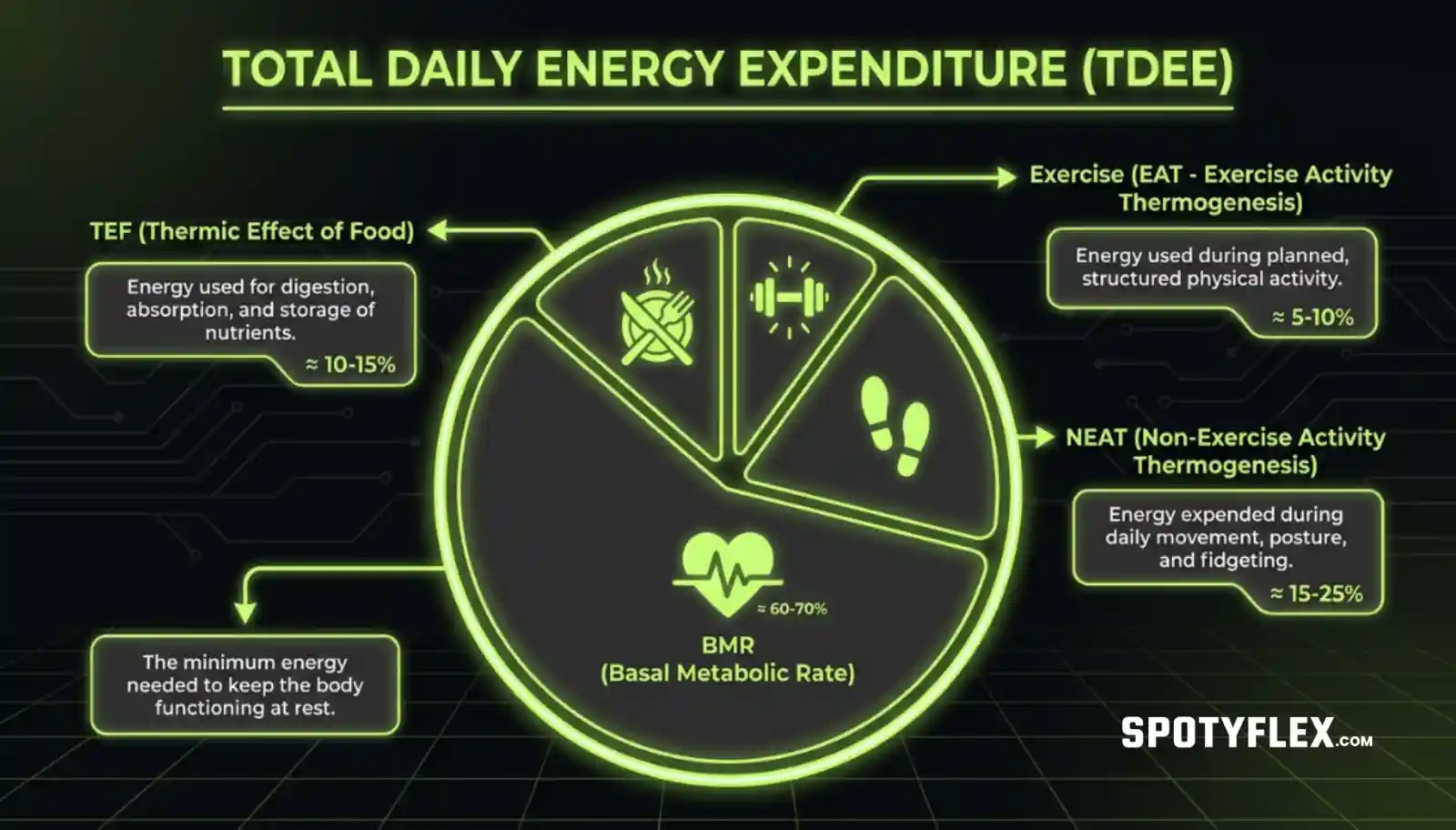
Here's the table version, since it's genuinely easier to digest at a glance than four separate paragraphs.
TDEE At a Glance
BMR — ~60-70% of TDEE — driven by body size and muscle mass
NEAT — ~15-30% of TDEE — driven by daily movement and occupation, huge person-to-person variation
TEF — ~10% of TDEE — driven by what and how much you eat, protein costs the most
EAT — ~5-10% of TDEE for most non-athletes — driven by structured exercise
Notice what's missing from that list: some hidden dial labeled "metabolism speed" that some people are born with and others aren't. There isn't one. There's just four buckets, and the size of each bucket is mostly explained by things you can actually see and measure, body size, muscle mass, activity level, and what's on your plate. That's the reframe this whole article is built around. If you haven't already, our TDEE calculation guide walks through getting your own rough number.
Chapter 2: Why People Think They Have a Slow Metabolism
If metabolism isn't some fixed lottery ticket, why does it feel so real that some people can "eat anything" and others "look at a cookie and gain weight"? Because several genuinely real factors are quietly stacking up in the background, and none of them are as dramatic as "broken."
Age
Metabolic rate does decline with age, but slower and later than most people assume, and the decline itself isn't really about age as a number. It's almost entirely explained by what tends to happen alongside aging: gradual muscle loss and reduced daily activity. A 45-year-old who lifts weights and stays active can easily have a higher metabolic rate than a sedentary 25-year-old. Age is a proxy, not the actual cause.
Muscle Loss
Muscle tissue is metabolically active, it costs energy just to maintain, even at rest. Lose muscle through years of inactivity or repeated crash dieting, and your BMR quietly drops along with it. This is the actual mechanism hiding behind most "my metabolism slowed down as I got older" stories.
Inactivity
Desk job, long commute sitting down, evenings on the couch, this is where NEAT quietly collapses without anyone noticing. Remember that 2,000 kcal/day swing we mentioned earlier. Someone who used to walk a physical job and now sits at a screen all day can lose an enormous chunk of daily burn without changing a single thing about their "diet."
Crash Dieting
Repeated cycles of extreme calorie restriction teach your body to become more efficient, and not in a way that helps you. We'll get into the actual mechanism in Chapter 6, but the short version is: yo-yo dieting is one of the more reliable ways to end up feeling like your metabolism betrayed you.
Genetics
Genuine individual variation in BMR does exist, somewhere in the range of a few hundred calories between people of otherwise similar size. It's real, it's just smaller than most people assume, and it's rarely the deciding factor between someone who's stuck and someone who isn't.
Thyroid and Medical Conditions
Conditions like hypothyroidism genuinely do slow metabolic rate, and they're more common than people think, especially in women. This is real and worth taking seriously, it's just not something an article, a coach, or frankly anyone without a blood test can diagnose for you.
When to See a Doctor
Persistent, unexplained fatigue, unexpected weight changes in either direction, hair thinning, feeling cold constantly, or a heart rate that seems consistently off are all worth bringing to a doctor. Blood work is the only real way to check thyroid function or rule out other medical causes, don't try to self-diagnose this one off a symptom checklist.
Chapter 3: Can You Actually Increase Your Metabolism?
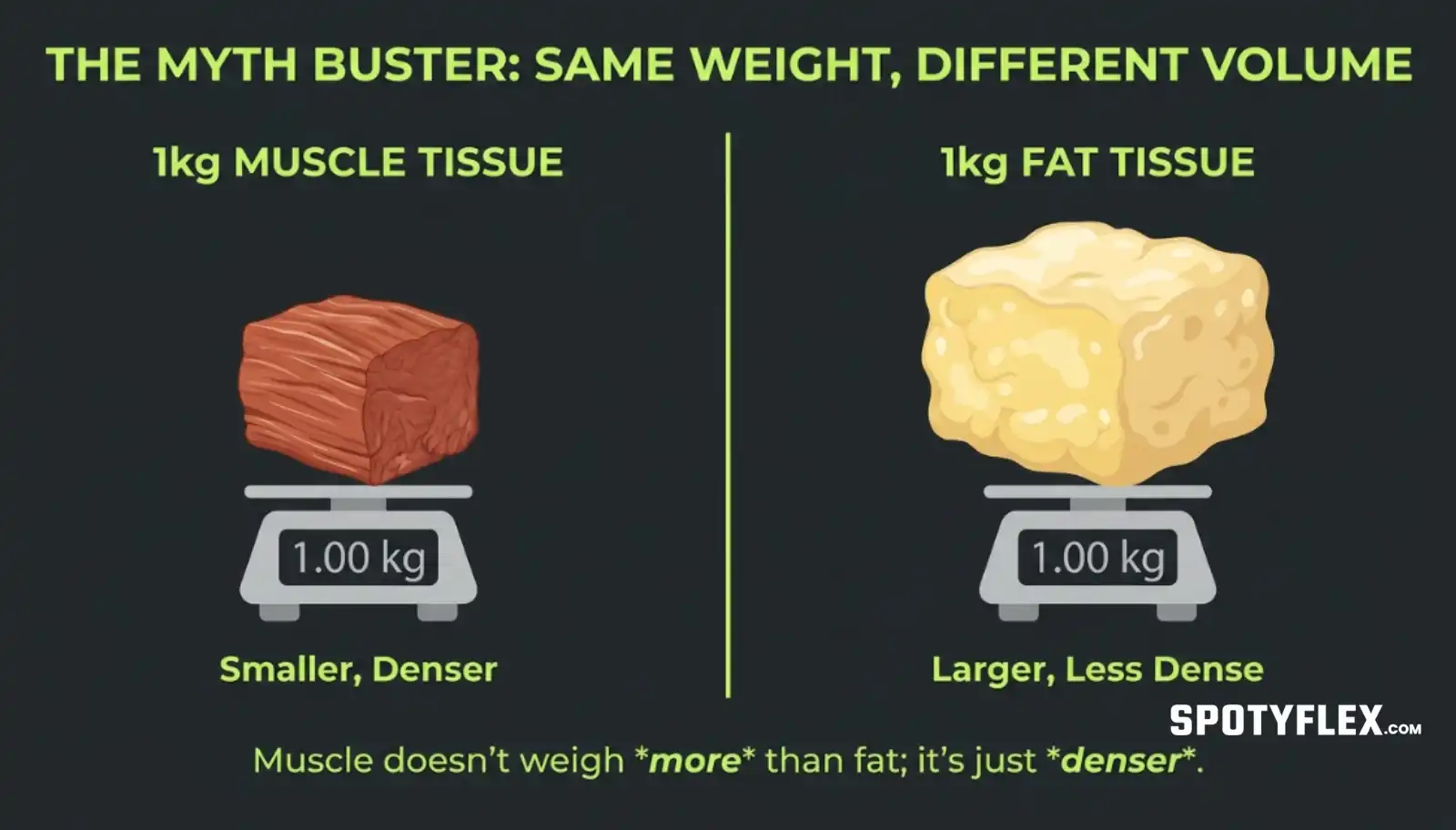
Short answer: yes, within a real but modest range, and the honest ways to do it are less exciting than a supplement label but they actually work.
✔ What Actually Works
Strength training. More muscle mass means a higher resting energy cost, day in, day out, whether you're at the gym or asleep. This is the single most reliable long-term lever available to you. Our progressive overload guide covers how to actually build that muscle over time.
Protein intake. Beyond the direct thermic effect we covered in Chapter 1, adequate protein helps preserve the muscle you already have, especially important during any kind of calorie deficit. Check our protein guide for actual target numbers.
Sleep. Poor sleep messes with the hormones that regulate hunger and energy balance, and it makes holding onto muscle during a diet noticeably harder. We go deeper on the mechanism in our sleep and recovery guide.
Daily movement (NEAT). Given how large that 2,000 kcal/day variance can be between two similarly-sized people, this might genuinely be the highest-leverage, lowest-effort lever on this entire list. Small, unglamorous, compounding.
Building and maintaining muscle generally, since it's the one component of BMR you have meaningful long-term control over. Nobody's rewriting their genetics, but almost everyone can add muscle.
❌ What Doesn't Work (Or Barely Moves the Needle)
Fat burner pills. Most rely on stimulants that produce a tiny, temporary bump in calorie burn, nowhere close to what's implied on the label, and often at the cost of your sleep or your nervous system feeling wired and wrong.
Detox teas. These mostly work through mild laxative or diuretic effects, water weight and digestive contents leaving your body, not fat. The number on the scale moves, your actual body composition doesn't.
Magic foods. Cinnamon, apple cider vinegar, grapefruit, chili peppers, green tea, all of these have been marketed at some point as metabolism boosters. Some have genuinely measurable but tiny thermogenic effects in controlled studies. None of them meaningfully move your day-to-day energy expenditure. If a food could reliably solve fat loss on its own, we'd all know its name by now.
Chapter 4: The Biggest Metabolism Myths
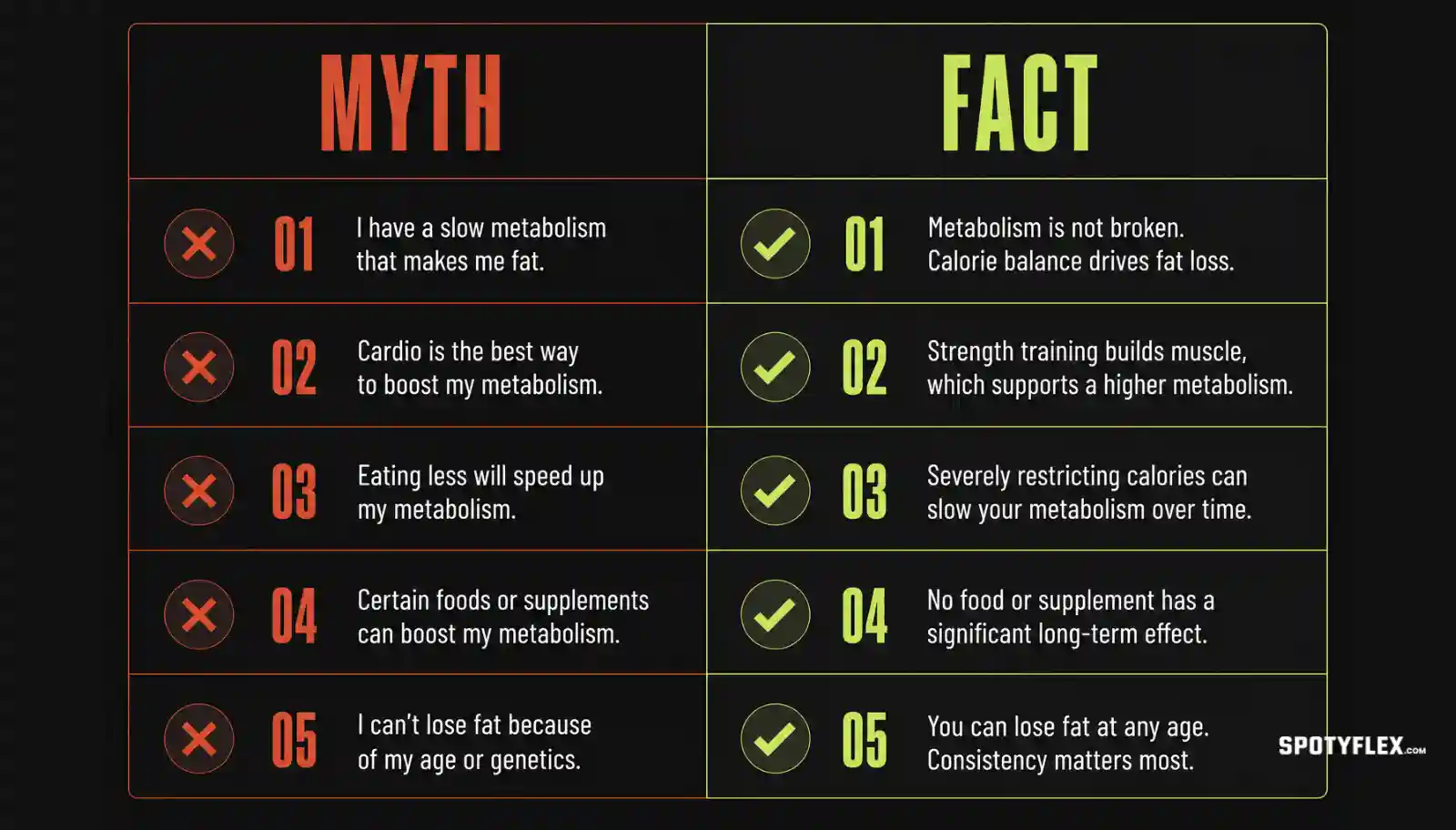
Some of these are so repeated they've basically become folk wisdom. None of them hold up.
"You need to eat every 2 hours or your metabolism shuts down"
Meal frequency has shown no meaningful independent effect on total metabolic rate when total calories and protein are held constant. Your metabolism doesn't panic and shut down because you went four hours without a snack. This myth mostly survives because eating frequently can help some people manage hunger, which is a real benefit, just not the mechanism people think it is.
"Lemon water burns fat"
Lemon water is hydrating and a genuinely pleasant way to start a morning. It does not burn fat. There's no citrus-triggered metabolic switch.
"Coffee melts fat"
Caffeine does produce a small, real, temporary increase in energy expenditure and can mobilize fatty acids into the bloodstream, but "mobilized" isn't the same as "burned," and the effect is far too small to meaningfully change body composition on its own.
"You go into starvation mode after skipping one meal"
The adaptive slowdown we'll cover in Chapter 6 is real, but it happens gradually, over weeks of sustained deficit, not because you skipped lunch on a busy Tuesday. Your body is considerably less dramatic than this myth suggests.
"Eating after 8pm causes fat gain"
Your body doesn't check a clock before deciding whether to store calories as fat. What matters is your total intake across the day relative to what you burn. Late-night eating is only a problem when it consistently pushes you over that total, the timing itself is basically irrelevant.
Chapter 5: What Actually Burns the Most Calories
If the goal is maximizing daily energy expenditure, here's an honest ranking of where your effort is best spent, and it might surprise you which one wins on volume.
Walking
Individually low intensity, but because it's sustainable for long durations and easy to accumulate throughout an entire day, walking is one of the single biggest contributors to NEAT and, by extension, total daily burn for most people. It's also basically free of injury risk and recovery cost.
Running
Higher calorie burn per minute than walking, but it comes with a real recovery cost and a much lower ceiling for how much of it you can sustainably do day after day without burning out or getting hurt.
Lifting Weights
Modest calorie burn during the actual session itself, but the real payoff is indirect and long-term: the muscle you build raises your baseline BMR for as long as you maintain it. This is a compounding investment, not a one-time burn.
HIIT
High calorie burn per minute and a real, if often overstated, "afterburn" effect (excess post-exercise oxygen consumption). Effective, but demanding on recovery and not something most people can or should do daily.
Daily Activity (NEAT)
Circling back to where we started: given how much NEAT varies between people, and how much of your day it fills compared to any single workout, this is genuinely the biggest total contributor for most non-athletes. A physically active job plus a sedentary hobby life will often out-burn a desk job plus one hour at the gym.
2,000
kcal/day is roughly how much NEAT alone can vary between two people of similar size, larger than most single workouts
None of this means skip the gym, strength training earns its place for reasons beyond pure calorie burn. It means don't underrate the hours you're not exercising, they add up to more than the hour you are.
Chapter 6: Metabolism After Losing Weight
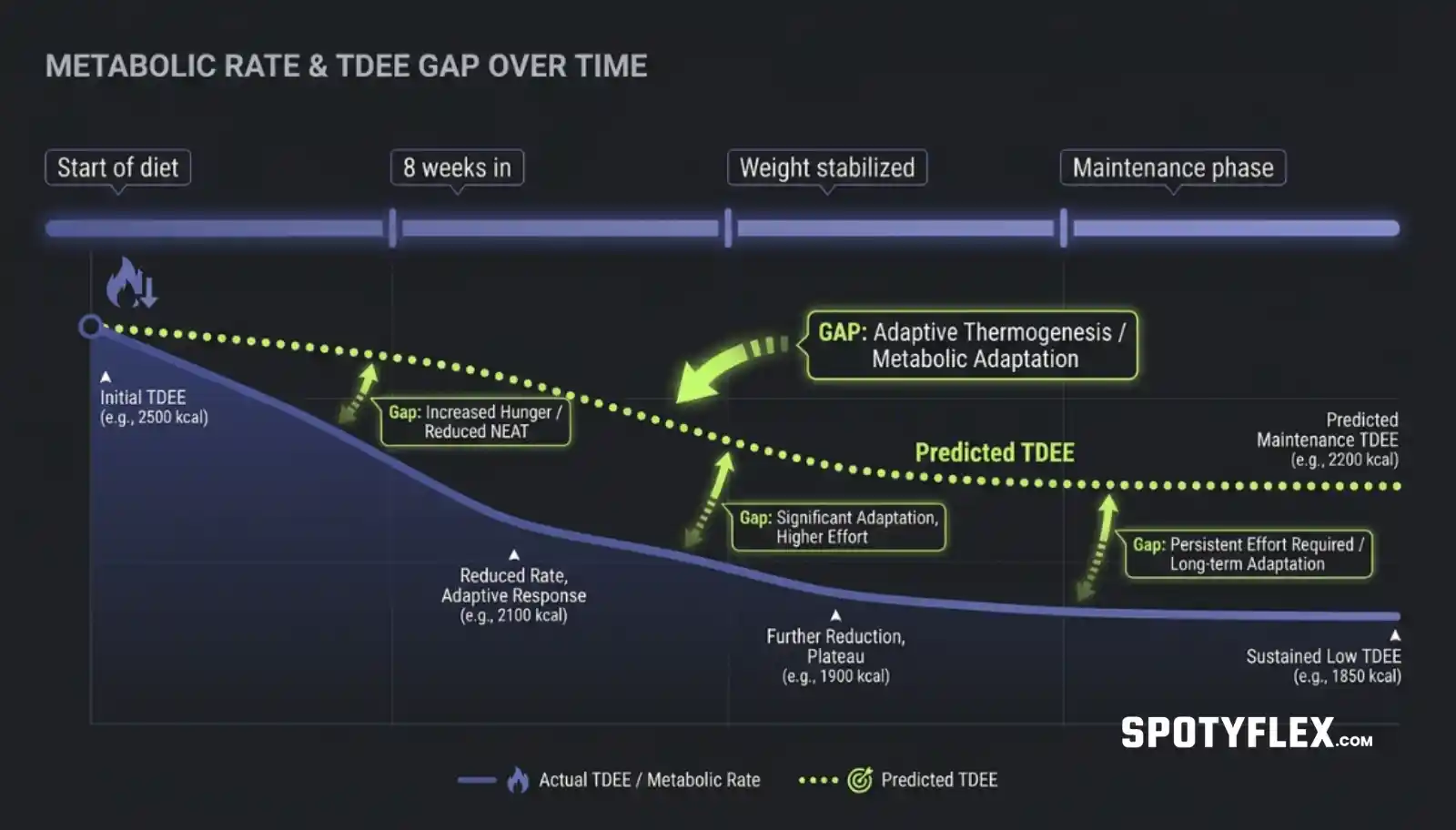
This is the chapter that explains why so many people genuinely feel like their metabolism is "broken" after a diet, and the honest answer is: something real did happen, it's just not permanent damage.
It's called adaptive thermogenesis, and it's your body's built-in defense against sustained energy deficits. A comprehensive review on the topic explains it clearly: energy restriction is accompanied by changes in circulating hormones, mitochondrial efficiency, and energy expenditure that serve to minimize the energy deficit, attenuate weight loss, and promote weight regain. Translated: the longer and harder you diet, the more your body quietly turns down the dial, BMR, NEAT, and TEF, all drop a bit more than your reduced body weight alone would predict. It's not sabotage, it's an old survival mechanism that doesn't know the difference between "intentional fat loss" and "famine."
Here's the part that actually matters for anyone who's dieted before and felt stuck afterward. The same research indicates these adaptations can persist even after weight loss has stopped, in people who have maintained a reduced body weight for over a year, meaning that slower-than-expected metabolic rate you're noticing post-diet isn't imaginary. It's a documented, measurable phenomenon.
What it is not, is permanent or irreversible damage. Metabolic rate tends to recover meaningfully with time, adequate food intake, and especially with regained or newly built muscle mass. This is exactly why crash diets are such a bad long-term trade, they maximize this adaptive response for minimal lasting benefit. It's also why a slower, more moderate approach tends to preserve more of your metabolic rate along the way, something we cover in more detail in our fat loss plateau guide and our calorie deficit guide.
What I Tell Beginners
When someone tells me their metabolism feels "wrecked" after a diet, I don't argue with the feeling, because something real is going on. What I do explain is that it's a temporary adaptation, not a life sentence, and that the fastest way out is usually the thing that feels counterintuitive: eating back up toward maintenance for a while, keeping protein and training consistent, and giving the system time to recalibrate instead of immediately diving into an even harder diet. This is general education, not a personalized medical plan, so if something feels off beyond normal post-diet sluggishness, a doctor is the right next call, not another Google search.
Chapter 7: How to Support a Healthy Metabolism
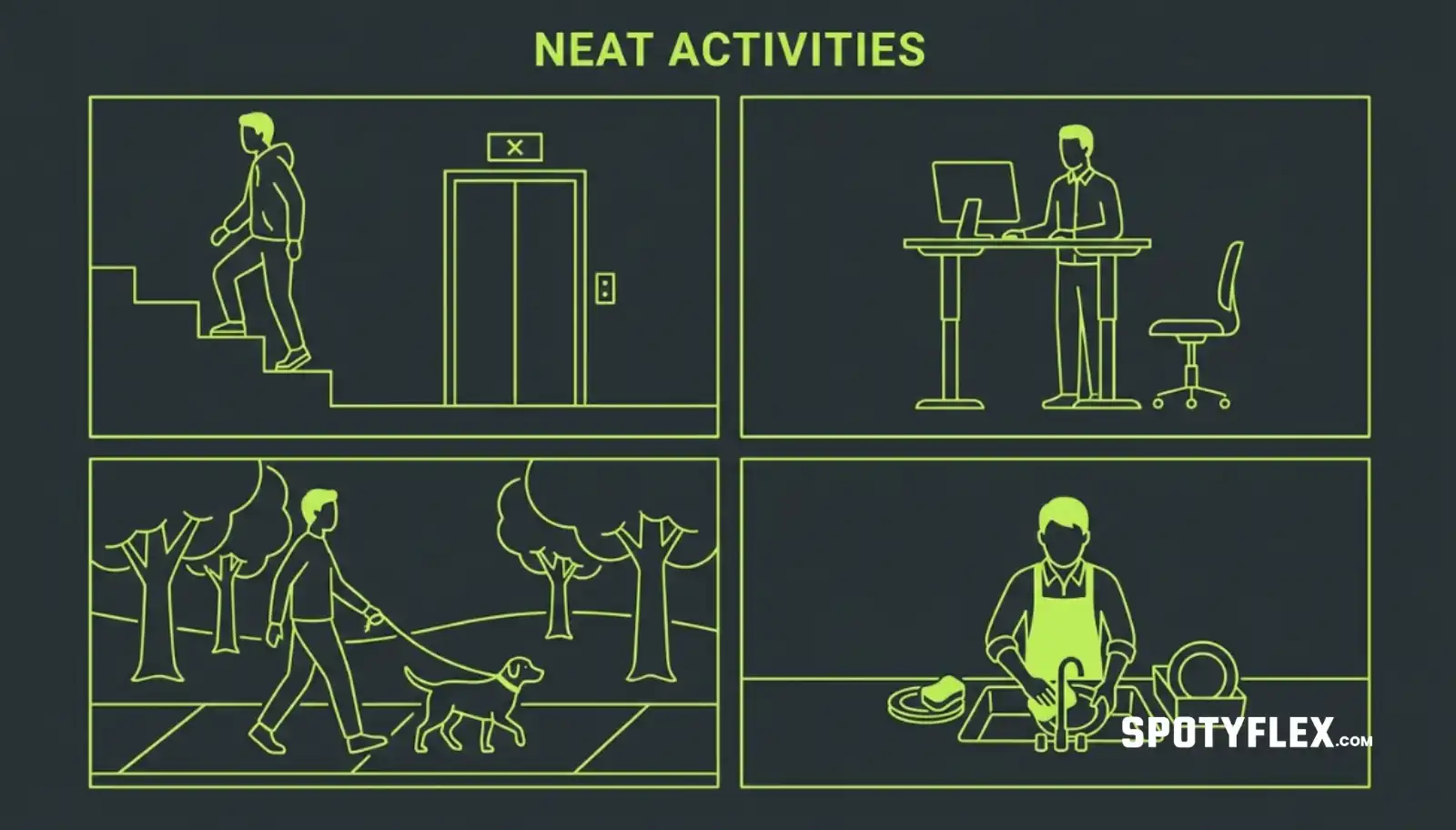
None of this requires a supplement stack or a dramatic overhaul. It's the same handful of fundamentals doing almost all of the work, which is a little anticlimactic but also genuinely good news, because it means the plan is simple even if it isn't always easy.
- Protein: Enough to support the thermic effect and protect muscle, especially during any calorie deficit. See our protein intake guide.
- Sleep: 7-9 hours most nights, treated as part of the plan rather than an afterthought. Our sleep and recovery guide covers why this matters more than most people assume.
- Lifting: Consistent resistance training to build and protect the muscle mass driving your BMR.
- Hydration: Supports basically every metabolic process in your body. Our hydration guide has the specifics.
- Movement: Prioritizing NEAT throughout the day, not just a single workout block. Our walking and NEAT guide and our NEAT explainer go deeper here.
- Stress management: Chronic stress and elevated cortisol can quietly work against your goals in ways that have nothing to do with willpower. Covered in full in our cortisol and fat loss article.
- Patience: Not a supplement, not a hack, still probably the single most underrated tool on this list.
Chapter 8: Frequently Asked Questions
Can you permanently damage your metabolism?
Not in the sense of irreversible destruction. Adaptive thermogenesis can genuinely persist for a while after aggressive dieting, but metabolic rate tends to recover with adequate food intake, time, and rebuilt muscle mass.
Does cardio slow metabolism?
Not directly. Excessive cardio combined with inadequate food intake can contribute to muscle loss over time, which does lower BMR, but that's a calorie and recovery issue, not something inherent to cardio itself.
Does lifting weights increase metabolism?
Yes, primarily through building and maintaining muscle mass, which raises your resting energy cost over the long term. This is one of the most well-supported levers in this entire article.
Does metabolism slow down after 30?
Some decline happens, but it's gradual and mostly explained by muscle loss and reduced activity that tend to accompany aging, not age itself as some kind of switch.
Does drinking cold water boost metabolism?
There's a tiny, real effect from your body warming the water to body temperature, but it's small enough to be irrelevant for actual fat loss outcomes. Drink water because you need to hydrate, not as a metabolism strategy.
Can supplements speed up metabolism?
Most produce negligible or purely temporary effects. Creatine and adequate protein support performance and muscle retention indirectly, but no supplement replaces training, sleep, and daily movement.
Does fasting slow metabolism?
Short-term fasting (hours, even a day or so) doesn't trigger the dramatic slowdown people fear. Prolonged, severe, and repeated caloric restriction is what drives adaptive thermogenesis, not the act of fasting itself.
Why do two people eat the same but weigh differently?
Differences in muscle mass, NEAT, genetics, hormones, and even how efficiently each person's gut absorbs nutrients all stack together. It's rarely one single factor, it's usually several small ones compounding.
Is it true that muscle burns way more calories than fat?
Muscle is more metabolically active than fat, but the commonly cited numbers are often exaggerated. The real value of muscle is less about the calories it burns sitting there and more about what it does for your BMR and body composition over the long run.
Can stress actually affect metabolism?
Indirectly, yes. Chronic stress affects sleep, appetite regulation, and cortisol patterns, all of which can influence eating behavior and energy balance even if cortisol itself isn't directly "slowing" your metabolism the way people imagine.
Do "metabolism boosting" foods actually work?
Foods like chili peppers, green tea, and coffee have measurable but very small thermogenic effects in research settings. Not nothing, but nowhere near enough to be a strategy on their own.
Is a slow metabolism why I can't lose weight?
Possible in rare cases involving a genuine medical condition, but for most people, a stalled fat loss journey traces back to underestimated calorie intake, inconsistent tracking, low activity, or unrealistic expectations, not a fundamentally broken system.
Final Takeaway
Your metabolism isn't a slot machine you either won or lost at birth. It's four measurable pieces, BMR, NEAT, TEF, and exercise, and three of those four respond directly to things you actually control: how much muscle you carry, how much you move throughout the day, and what you eat. The fourth, genetics, matters less than the industry selling you "metabolism boosters" wants you to believe.
If you take one thing from this entire article, let it be this: stop hunting for the one trick that flips your metabolism into a higher gear, and start stacking the boring fundamentals that actually move it, protein, sleep, lifting, daily movement, and enough patience to let adaptive thermogenesis work itself back out if you've dieted hard in the past. That combination has never once let anyone down long-term. Fat burner pills can't say the same.
Sources & References
- Trexler ET, Smith-Ryan AE, Norton LE. Metabolic adaptation to weight loss: implications for the athlete. PubMed — Journal of the International Society of Sports Nutrition, 2014
- Levine JA. Nonexercise activity thermogenesis — liberating the life-force. PubMed — Journal of Internal Medicine, 2007
- Halton TL, Hu FB. The effects of high protein diets on thermogenesis, satiety and weight loss: a critical review. PubMed — Journal of the American College of Nutrition, 2004

/1.webp)
