


You're training.
You're eating "clean".
You're doing everything right.
And the scale hasn't moved in three weeks.
So what gives?
It's not your genetics. It's not your metabolism. It's not bad luck.
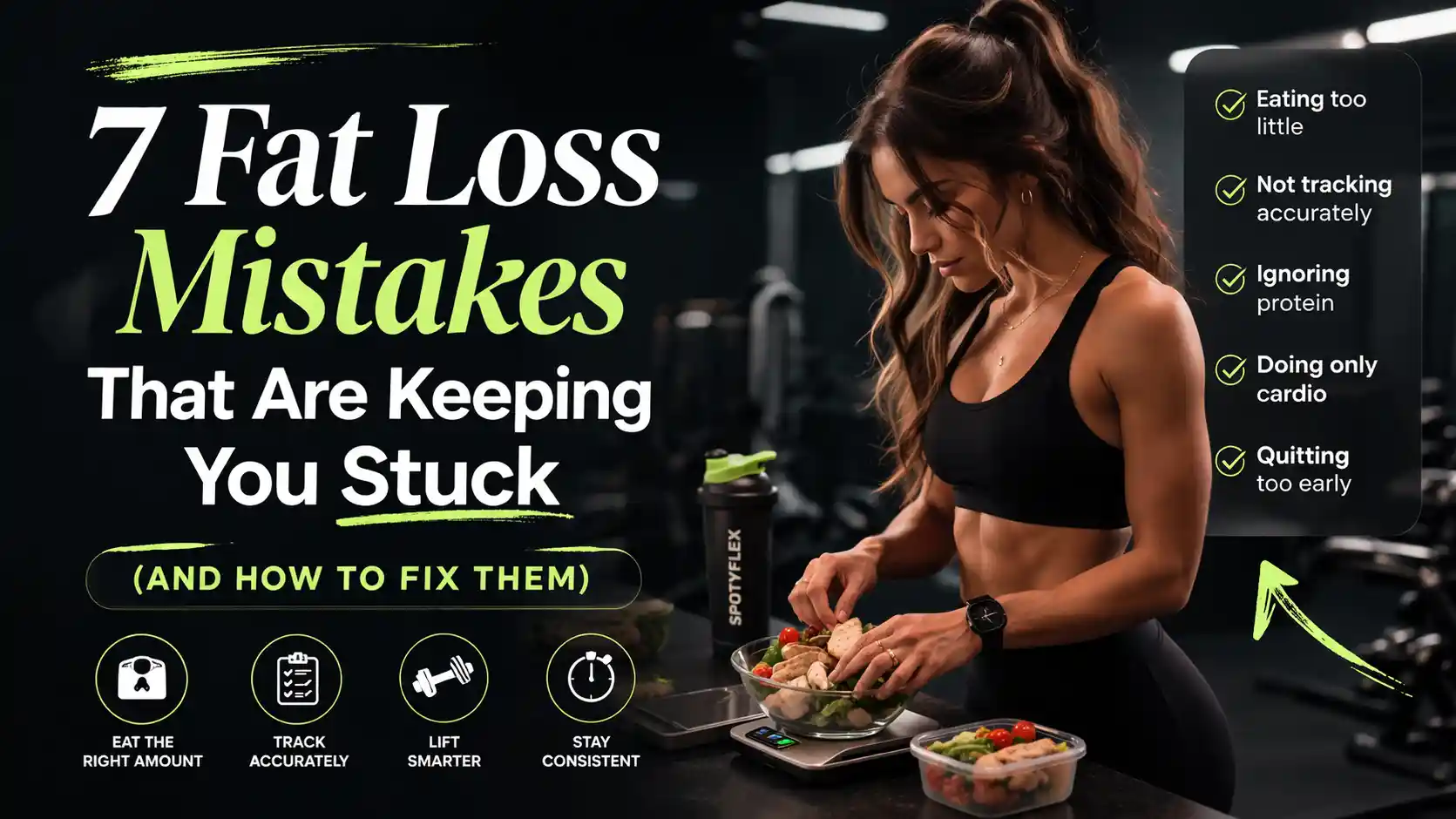
It's one — or more — of these 7 mistakes. And every single one is fixable.
You're Eating Too Little
This one surprises people every time.
Eating too little is a fat loss mistake?
Yes. And it's more common than you think.
When you slash calories too aggressively — eating 1,200 when your body actually needs 2,200 — here's what happens:
- Your metabolism slows down to compensate
- Your body breaks down muscle for energy — not just fat
- Hunger hormones go into overdrive
- You binge. You feel guilty. You repeat.
The result? You've lost muscle, slowed your metabolism, and regained the fat. You end up in a worse position than before you started.
"Eat less" is not a strategy. "Eat the right amount less" is.
→ The Fix
Eat 300–500 calories below your TDEE — not 1,000 below it. You need to know your real number first: How to Calculate Your TDEE →
You're Not Tracking Accurately
Here's an uncomfortable truth.
Studies consistently show that people underestimate their calorie intake by 20–40%.
That's not a rounding error. At 2,000 calories per day, that's 400–800 hidden calories. Every. Single. Day.
It happens like this:
Most people who say they're eating 1,500 calories are eating closer to 2,000. That's not a deficit. That's maintenance.
→ The Fix
Use a food scale for 4–6 weeks. Track oils, sauces, drinks — everything. You only need to do this long enough to calibrate your eye. After that, you'll know what a real portion looks like.
You're Not Eating Enough Protein
When you're in a calorie deficit, your body needs energy.
It will get it from fat. But without enough protein, it will also get it from your muscle.
That's the part nobody wants to talk about.
You can lose weight and end up with a worse body composition than when you started. Smaller, but still soft. Lighter, but still not the physique you were after.
Protein prevents that. It tells your body to preserve muscle and burn fat instead. It also keeps you fuller longer and burns more calories during digestion than carbs or fat. It's the most important macro you're probably underrating.
Your Daily Target
1.6–2.2g per kg
For a 75kg person → 120–165g of protein daily
→ The Fix
Build every meal around a protein source first. Chicken, eggs, fish, Greek yogurt, cottage cheese, legumes. Everything else comes after. Full breakdown here: Understanding Macros →
You're Only Doing Cardio
Cardio burns calories. That's true.
But if cardio is your only tool — you're missing the bigger picture.
Cardio-only fat loss has a well-known problem: you get smaller, but your body composition barely changes. You lose fat and muscle at the same rate. You end up "skinny fat" — lighter on the scale, but still soft and undefined.
Resistance training changes the equation entirely.
- It builds and preserves muscle
- More muscle = higher resting metabolism (you burn more calories 24/7)
- It creates the shape and definition cardio never will
- The afterburn effect keeps you burning calories hours after the session
Cardio gets you smaller. Lifting gets you lean. There's a difference — and it's a big one.
→ The Fix
Add resistance training 3x per week minimum. Keep cardio as a supplement, not the foundation. Build your weekly workout plan →
Only "Good" Monday to Friday
Monday to Friday you're dialled in. You hit your calories. You train. You're focused.
Then the weekend arrives.
And it all goes sideways.
This is one of the most common patterns that kills fat loss — and the math is brutal.
| Days | vs TDEE | Balance |
|---|---|---|
| Mon–Fri (×5) | −500 cal/day | −2,500 cal |
| Sat–Sun (×2) | +1,000 cal/day | +2,000 cal |
| Real weekly deficit | −500 cal total |
You think you're running a 3,500 calorie weekly deficit. You're actually running 500. That's why the scale won't move.
→ The Fix
You don't need to be perfect on weekends. But you do need to be aware. Track loosely. One flexible day is fine. Two completely untracked days will stall most people cold.
Obsessing Over the Scale
Your bodyweight fluctuates by 1–3kg every single day.
Not fat. Not muscle. Water.
A salty meal, a carb-heavy day, hormonal shifts, stress, undigested food — all of it shows up on the scale the next morning. None of it is real fat gain. All of it looks terrifying if you're weighing yourself every day without context.
The scale measures your relationship with gravity at that exact moment. It does not measure your progress.
There's also something called the "whoosh" effect. Your body holds onto water as fat cells are emptying. The scale stays flat for 2–3 weeks — then suddenly drops 1–1.5kg overnight. People quit right before that drop happens.
→ The Fix
Weigh yourself daily, same time, same conditions. Then look at the 7-day average — not individual readings. Also track: how clothes fit, progress photos every 4 weeks, your strength in the gym. These don't lie the way the scale does.
You're Quitting Too Early
This is the one that hurts the most to read.
Because most people who quit — were actually working.
They just didn't know it yet.
Fat loss is slow. Genuinely, frustratingly slow. At a healthy rate of 0.5kg per week, you won't see dramatic visible results in two weeks. Most people expect transformation in two weeks and quit when they don't get it. They were almost certainly on track. They just stopped too soon.
What Actually Happens Over Time
Week 1–2
Water weight drops. Energy starts improving. You feel something shifting.
Week 4–6
Clothes start fitting differently. People who see you regularly begin to notice.
Week 8–12
Visible changes in the mirror. You look at old photos and actually see the difference.
6 Months
Transformational difference. People ask what you've been doing. This is where everyone who quit wishes they hadn't.
→ The Fix
Commit to 12 weeks minimum before judging your results. Take progress photos every 4 weeks — the camera catches what the mirror and scale miss. Trust the process long enough for it to actually work.
The Fix Is Simpler Than You Think
You don't need a new diet.
You don't need a different program.
You need to fix one or two things you're already doing.
Most people who aren't losing fat are either eating more than they think, not eating enough protein, or not giving it enough time. Fix those three things — and results follow.
- Trexler ET, et al. Metabolic adaptation to weight loss: implications for the athlete. PubMed — Journal of the International Society of Sports Nutrition, 2014
- Dhurandhar NV, et al. Energy balance measurement: when something is not better than nothing. PubMed — International Journal of Obesity, 2015
- Helms ER, et al. A systematic review of dietary protein during caloric restriction in resistance trained lean athletes. PubMed — International Journal of Sport Nutrition, 2014
- Willis LH, et al. Effects of aerobic and/or resistance training on body mass and fat mass in overweight or obese adults. PubMed — Journal of Applied Physiology, 2012
- Comprehensive evidence summary on fat loss nutrition and calorie tracking. Examine.com — Fat Loss
Younes Ouba
Founder of SpotyFlex, Full-Stack Developer & lifelong fitness enthusiast. I build the platform and the content. The goal is always the same: real fitness knowledge, zero BS.

/1.webp)
